Current Transformer (CT) and current transducer are both essential devices for electrical current measurement and signal processing in power systems, industrial automation, and electrical engineering applications, yet they differ fundamentally in working principle, design purpose, output characteristics, and practical use cases. While CTs are specialized for high-voltage/high-current power system metering and protection, current transducers are versatile signal conversion tools for industrial control and automation, with overlapping but distinct functional scopes that make them irreplaceable in their respective scenarios. A clear understanding of their differences is critical for accurate device selection, safe system operation, and reliable data acquisition in electrical projects.
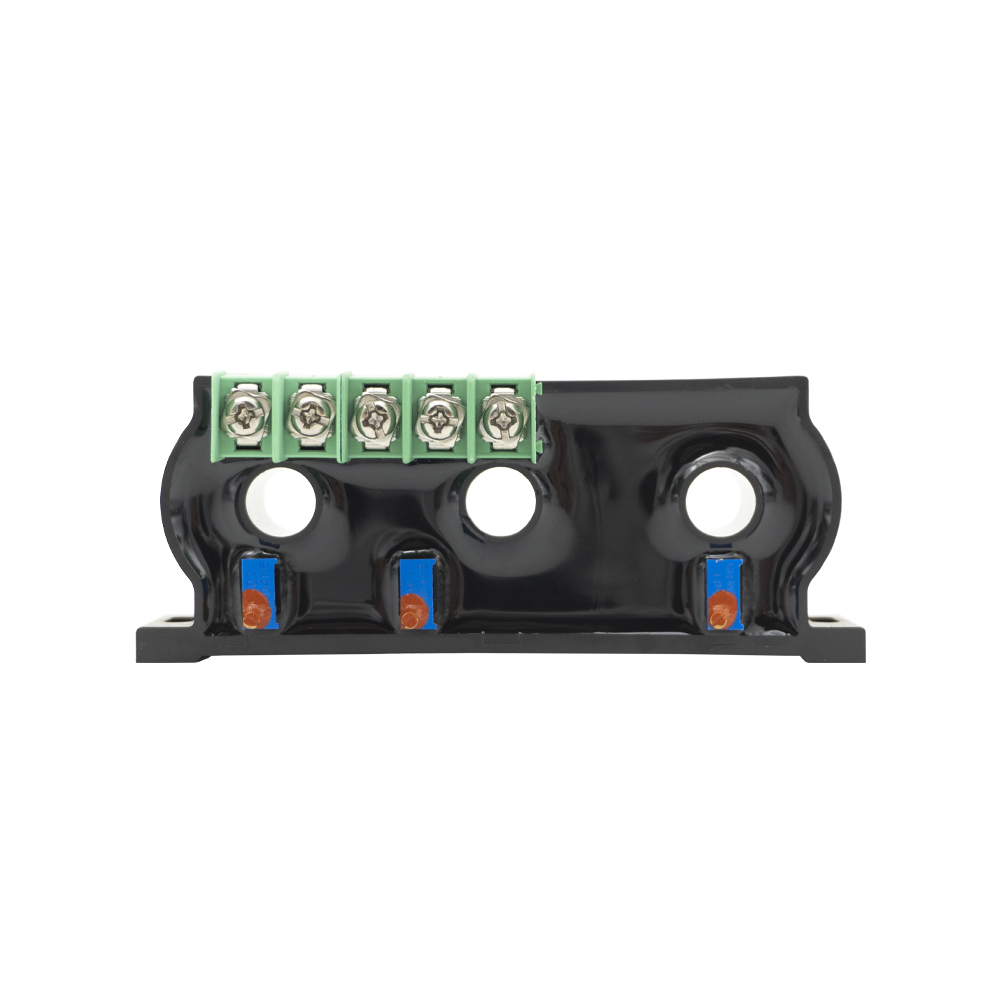
In terms of working principle, the current transformer is a passive electromagnetic device based on Faraday’s law of electromagnetic induction and the transformer principle. It consists of a primary winding, secondary winding, and closed iron core: the primary winding is connected in series with the measured current circuit, and the alternating current in the primary coil generates a changing magnetic flux in the iron core, which induces a proportional alternating current in the secondary winding. CTs are designed for alternating current (AC) measurement only and rely on the magnetic coupling between primary and secondary coils to achieve current transformation, with no external power supply required for their operation. By contrast, a current transducer (also called a current sensor or current transmitter) is an active electronic device that integrates electromagnetic induction, Hall effect, or shunt resistance principles with signal conditioning circuits. Most transducers use the Hall effect as their core working mechanism: a Hall element detects the magnetic field generated by the measured current (AC or DC), converts the magnetic signal into a weak voltage/current signal, and then amplifies, linearizes, and isolates this signal via an internal electronic circuit to produce a standardized output. Unlike CTs, current transducers require an external DC power supply (e.g., 24V DC) to power their electronic components, enabling them to process both AC and DC currents.
Output characteristics represent one of the most significant distinctions between the two devices. CTs produce an alternating current output that is a precise proportional replica of the primary AC current, with standard secondary outputs in power systems (e.g., 5A or 1A for industrial CTs, 100mA for miniature models). This output is an unconditioned raw electrical signal that requires matching secondary devices (e.g., ammeters, protective relays, energy meters) with corresponding input ranges for measurement or control. CT outputs are also subject to minor errors such as ratio error and phase error, which are strictly calibrated for power system accuracy requirements (e.g., 0.2 class for metering, 5P class for protection). Current transducers, by contrast, deliver standardized, conditioned electrical signals suitable for direct connection to industrial automation equipment such as PLCs, DCS systems, data loggers, and analog meters. Their common output formats include 4-20mA DC, 0-5V DC, or 0-10V DC, where the signal magnitude is linearly proportional to the measured current. This standardized output eliminates the need for additional signal conditioning and ensures compatibility with modern control systems, with high linearity and low error across the measurement range.
Application scope and design objectives further separate CTs and current transducers. Current transformers are purpose-built for high-voltage (HV) and medium-voltage (MV) power systems, as well as low-voltage (LV) high-current industrial circuits. Their primary functions are electrical metering (e.g., energy billing) and protective relaying (e.g., overcurrent/short-circuit protection), and they are designed to meet strict power system standards for insulation, accuracy, and thermal stability. CTs provide electrical isolation between the high-voltage primary circuit and the low-voltage secondary circuit, a critical safety feature for protecting personnel and secondary equipment in power grids, substations, and large industrial motor control centers. They are exclusively used for AC current measurement and cannot process DC currents, with their design optimized for the 50/60Hz power frequency range. Current transducers, on the other hand, have a broad, cross-industry application scope spanning low-voltage industrial automation, building automation, renewable energy systems (solar/wind), and electronic equipment testing. They are used for real-time current monitoring, process control, and data acquisition in scenarios where both AC and DC current measurement is required, such as variable frequency drive (VFD) systems, battery charging/discharging circuits, and DC power supplies. Transducers prioritize versatility, compact size, and easy integration with control systems over high-voltage insulation, and they are typically used in low-voltage (≤690V) circuits. Some high-performance transducers also offer electrical isolation between the input and output circuits, but this is an optional feature rather than a core design requirement.
Installation and operational requirements also vary between the two devices. CTs are relatively large, heavy devices (especially HV/MV models) that require fixed installation in electrical panels, switchgears, or outdoor substations, with strict wiring rules for the secondary circuit (e.g., the secondary winding must never be open-circuited, as this can generate dangerous high voltages). Their installation and maintenance require compliance with power system safety regulations and professional electrical expertise. Current transducers are compact, modular devices available in panel-mount, DIN-rail mount, or split-core clamp-on designs, enabling easy installation and retrofitting in industrial control panels and electrical enclosures. Split-core transducers eliminate the need to disconnect the measured circuit during installation, significantly reducing downtime for maintenance and retrofitting. The operational rules for transducers are simpler: they only require a stable external power supply and correct wiring of the input (measured current) and output (standard signal) circuits, with no risk of open-circuit hazards. This ease of installation and operation makes transducers ideal for small-scale industrial applications and field monitoring.
In summary, the current transformer is a passive, induction-based device for AC power system metering and protection, with high-voltage isolation and power frequency optimization as its core features. The current transducer is an active, electronic signal conversion device that processes both AC and DC currents, delivering standardized outputs for industrial automation and control. While both devices measure current, their working principles, output formats, and application scenarios are mutually exclusive in most cases: CTs are indispensable in power grids and high-voltage industrial power systems, while current transducers are the go-to choice for low-voltage automation, DC system monitoring, and integration with modern control equipment. In some complex electrical systems, however, they may be used together—for example, a CT measures the high-voltage AC current in a power system, and its output is fed into a current transducer to convert the 5A AC signal into a 4-20mA DC signal for remote monitoring via a PLC or SCADA system. Understanding these core differences ensures optimal device selection, reliable system performance, and safe operation in all electrical measurement and control applications.


