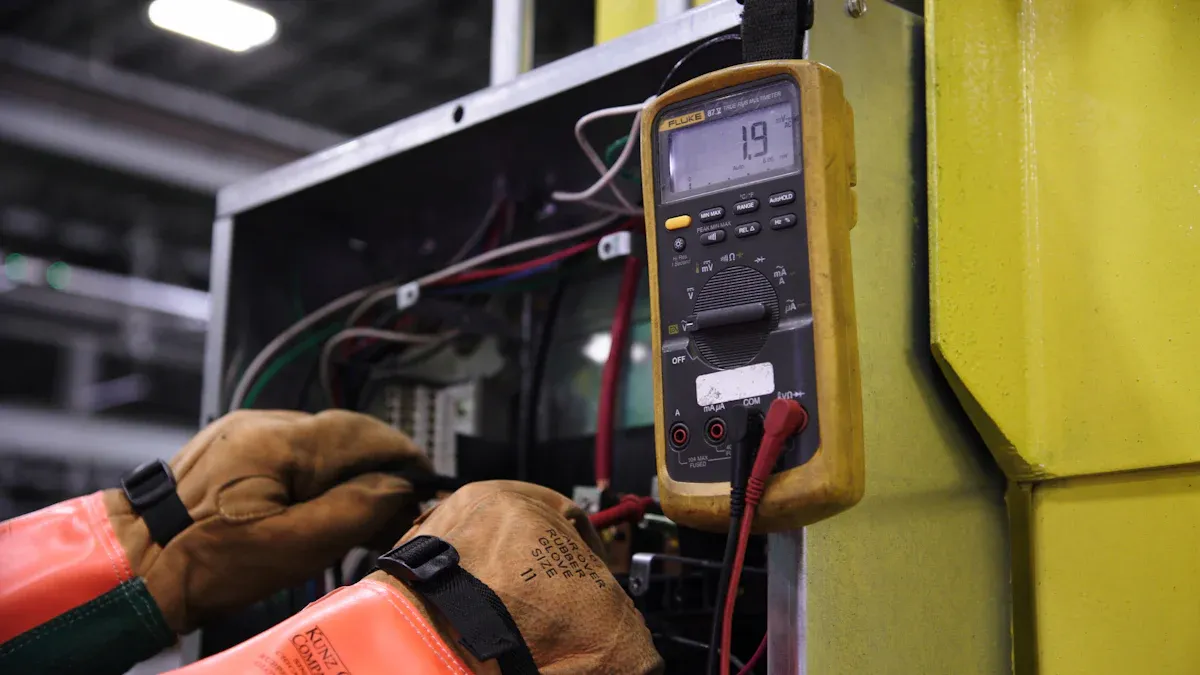
You use current transformers to check how much electricity flows. These devices help you see how much energy you use. They make it simple to track your power use. Accurate readings from current transformers are important for homes and big buildings. You can put them on main feeds, subpanels, or single circuits. This lets you watch certain areas. 
Key Takeaways
Current transformers (CTs) help measure electricity in a safe way. They lower high currents. This makes it easier to track energy use in homes and buildings.
Picking the right CT is very important for good readings. Think about things like load size and thermal ratings. Make sure it works with your energy monitoring equipment.
CTs keep things safe by finding overcurrents and short circuits. They turn on protective relays to stop damage and keep the system safe.
Using more than one CT in a channel can save space and money. But you might not see as much detail for each circuit.
Check and take care of your CTs often. This helps keep measurements correct and keeps your energy monitoring system safe.
Principle of operation
A current transformer helps you measure electricity safely at home or work. Its main job is to lower high currents to a safer level. This makes it safe to connect measuring tools. The current transformer uses electromagnetic induction to work. When AC flows in the main wire, it makes a magnetic field in the core. This field creates a smaller current in the secondary winding. The secondary current is always smaller but matches the main current. The main circuit stays almost the same, so the power flow is not changed.
The main current makes a changing magnetic field in the core.
This field creates a smaller current in the secondary winding.
The secondary current matches the main current but is smaller.
Electromagnetic induction moves energy from the main to the secondary winding.
The core gets magnetized when current flows, which makes a current in the secondary winding.
You can find current transformer in many places. They are used in buildings, panels, and circuits. They also help check wind turbines and solar systems. In all these cases, the current transformer lets you measure electricity without touching high voltage.
Measuring AC current
When you measure AC, you need to be safe and correct. The current transformer helps with both. It uses a turns ratio to keep the right link between the main and secondary currents. For example, if the main current is 100A and the secondary is 5A, the turns ratio is 20:1. This means the current transformer lowers the current by 20 times. The number of turns in the secondary winding controls how much the current drops.
The current transformer has a steel core and a secondary winding.
AC flows in the main wire and makes a magnetic field.
The magnetic field magnetizes the core and makes a voltage in the secondary winding.
If you close the secondary circuit, a current flows that matches the main current, but is smaller.
Current Range | Description |
1-5A | Typical output range for CTs |
0.333-1V | Alternative output range for CTs |
Current transformers keep you safe by lowering high AC currents. Never leave the secondary winding open when the main is on. This can make very high voltages. Some current transformers have built-in safety parts, like Zener diodes or burden resistors, to stop damage. Checking and testing often helps your system stay safe and correct.
You use CTs in many ways. You can check main utility feeds, subpanels, and renewable energy systems. CTs let you measure electricity in different parts of your building or equipment. This helps you watch energy use and save power.
Role of current transformers
Energy monitoring
You use cts to check how much electricity you use each day. These devices show you current flow right away. This helps you see where you use the most energy. When you use current transformers with a power meter, you can watch your energy use more closely. This is called current monitoring. It helps you notice patterns and find ways to save money.
cts give important data for checking loads.
They help you track energy use exactly.
cts make sure you follow reporting rules.
They lower high currents so it is safe to measure and control energy.
Circuit protection
cts also help keep your electrical system safe. They look for problems like too much current or short circuits. When cts find these problems, they can turn on relays that protect the circuit. These relays turn off the bad part to stop damage or fire. This keeps people and equipment safer.
Functionality | Description |
Detect overcurrent and short-circuit | cts watch current to find dangerous problems. |
Activate protective relays | They turn on relays to quickly shut off bad parts. |
Provide electrical isolation | This keeps people and equipment safe from high voltages. |
cts also protect you from electric shock by keeping measuring tools away from high voltage. Some cts can find small leaks of current. This stops heat from building up and causing fires. In big panels, cts help find problems with insulation, screen faults, and slow leaks. Using cts for circuit protection keeps your system working well and safe.
Selecting current transformers
Picking the right cts helps you get good data. It also keeps your system safe. You should think about a few things before you choose a current transformer. The best choice lets you watch your energy use and keeps your equipment safe.
Sizing and compatibility
Your cts must match your electrical load. If you pick one too big or too small, your readings will be wrong. Always check the thermal ratings and the size. Look at how much space you have in your panel. Make sure the cts can handle the current you want to measure. The table below lists things you should think about:
Factor | Description |
Thermal Ratings | Shows the highest temperature the transformer can handle. |
Physical Size | Check the outside and inside size, especially if space is tight. |
Installation Requirements | Think about your setup and if you need to keep power on during installation. |
Accuracy Class | Pick a class that matches your meter for good readings. |
Power Requirements | Make sure the transformer gives enough power to avoid signal errors. |
Accuracy and precision
The accuracy class tells you how close your readings are to the real value. If you need to track energy for bills or reports, you need high-precision cts. The table below shows some accuracy classes and what they are used for:
Accuracy Class | Usage Type | Error Requirement |
0.1 | High precision metering | 0.1% at rated current |
0.2 | General metering | 0.2% at rated current |
0.5 | Common metering | 0.5% at rated current |
1 | Basic metering | 1% at rated current |
3 | Less precise applications | 3% at rated current |
5 | Less precise applications | 5% at rated current |
Installing current transformers
Wire placement
You must be careful when you put in current transformers. This helps you get the right readings. First, turn off the power before you start. Pick a good place for the transformer. Put it on the right wire and make sure the arrow faces the power source. Slide the main wire through the middle hole of the transformer. Hook up the secondary wires to your meter and check that the ground is tight.
Here are some tips for placing wires:
Make sure the wires are connected the right way. Use color codes so you do not get negative or backwards readings.
Put the transformer on the same phase as the voltage input. This helps stop mistakes in your readings.
Do not use wires that are too long. Pick the right size wire and keep them short for better accuracy.
If you need longer wires, use twisted-pair cables. This helps stop noise from messing up your readings.
Try not to use too many connectors and make sure all are tight.
Always check your work before you finish putting everything together.