A Hall effect current transducer is a sophisticated electronic device designed to measure electric current accurately and non-intrusively, leveraging the Hall effect—a physical phenomenon discovered by Edwin Hall in 1879. Unlike traditional current measurement methods that require direct electrical contact with the conductor, this transducer detects the magnetic field generated by the current flow, converting it into a proportional electrical signal that can be easily measured, processed, or displayed. This non-contact feature makes it ideal for high-voltage, high-current, and harsh industrial environments where safety and isolation are critical.
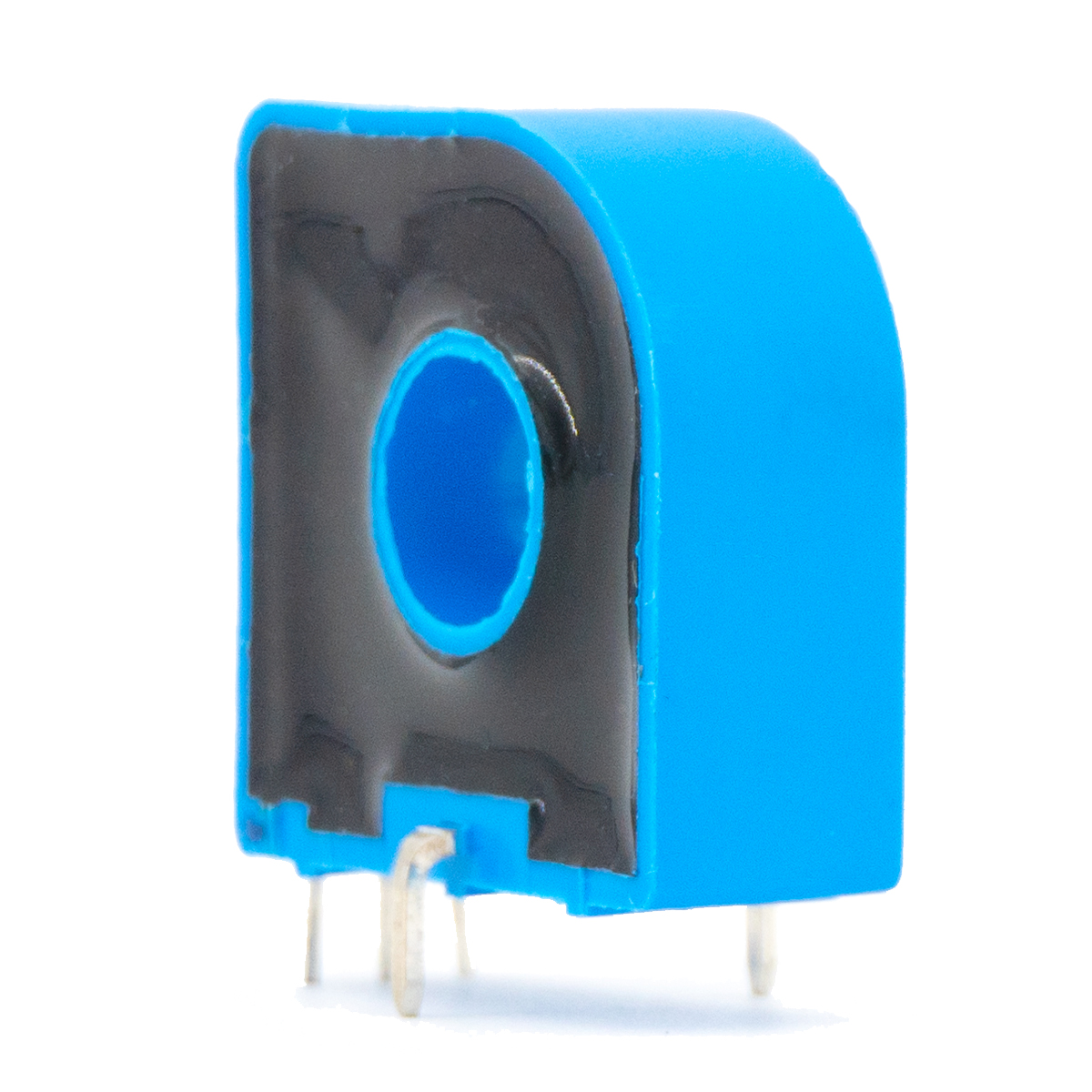

The core working principle of a Hall effect current transducer revolves around the Hall effect: when a current-carrying conductor is placed in a magnetic field, charge carriers (electrons or holes) within the conductor are deflected by the Lorentz force, creating a voltage difference (Hall voltage) across the conductor. In the transducer, a Hall element (typically made of semiconductor materials like silicon or gallium arsenide) is positioned in the magnetic field produced by the measured current. The magnitude of the Hall voltage is directly proportional to the strength of the magnetic field, which in turn is proportional to the current flowing through the conductor. By measuring this Hall voltage and processing it through signal conditioning circuits, the transducer outputs a standardized signal (such as 4-20mA or 0-10V) that corresponds to the actual measured current.
Hall effect current transducers are mainly categorized into two types: open-loop (uncompensated) and closed-loop (compensated) transducers. Open-loop transducers are simple in structure, low in cost, and have fast response times. They consist of a Hall element, a magnetic core to concentrate the magnetic field, and signal conditioning electronics. However, their accuracy is slightly lower due to temperature drift and magnetic saturation. Closed-loop transducers, on the other hand, incorporate a compensation coil that generates a magnetic field opposite to the one produced by the measured current, achieving magnetic balance. This design significantly improves accuracy, linearity, and stability, making them suitable for high-precision applications.
Key advantages of Hall effect current transducers include galvanic isolation between the measured current and the output signal, which prevents electrical interference and ensures operator safety. They also have a wide measurement range, from milliamps to thousands of amps, and can measure both DC and AC currents, as well as transient currents. Additionally, they are compact, lightweight, and have low power consumption, making them easy to integrate into various electronic systems.
These transducers find widespread applications across multiple industries. In the automotive sector, they are used in electric vehicles (EVs) and hybrid electric vehicles (HEVs) for battery management systems (BMS), motor control, and charging systems. In industrial automation, they are employed in motor drives, power inverters, and power distribution systems to monitor and control current. They are also used in renewable energy systems (solar and wind power), medical equipment, aerospace, and telecommunications, where accurate and reliable current measurement is essential for system performance and safety.


